





- A +
- A
- A -
Simply put, a bicycle saddle is an indispensable key component mounted on the bicycle seat post to provide support for sitting. As electric bicycles have gained widespread popularity thanks to their light‑weight, eco‑friendly features, the expansion of the electric‑bicycle market has also driven the development of the bicycle saddle market to a certain extent. In the coming years, enterprises within the bicycle saddle industry will continuously improve production technologies and upgrade product grades, which will lead to increasingly fierce competition in the industry. A certain manufacturer needs to make corresponding improvements to adapt to the current development situation by adopting 3D scanning technology for inspection and analysis.

On‑site scan image of the bicycle saddle
Practical problems
The bicycle saddle is fan‑shaped with a large curved arc surface. Its bottom is a complex concave structure fitted with mounting components. The front section is small in area and also curved inward, which tends to create dead zones and poses certain difficulties for scanning work.
When attempting to use a conventional 3D scanner, it worked for scanning smooth surfaces. However, scanning the bottom was rather time‑consuming with poor capture of fine details. The acquired 3D data had low accuracy, making precise scanning impossible and failing to meet the customer’s requirements. Therefore, a high‑tech scanner had to be sought as an alternative.
Co3d solution
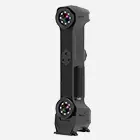
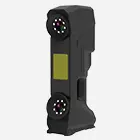
In accordance with customer requirements and workpiece characteristics, our engineers used the handheld 3D scanner HOLON760 to quickly perform scanning and acquire 3D data. The device adopts 7 sets of crossed laser lines plus one additional laser line, totaling 15 laser lines, which delivers a fast‑scanning speed. It can be switched to the single‑laser scanning mode, which is suitable for scanning deep holes and dead corners. The scanned data features high precision and better stability, greatly improving work efficiency. The acquired 3D data is imported into 3D inspection software for comparative analysis, which addresses issues in subsequent design and optimization. The overall scanning process is extremely fast with complete data acquisition and favorable scanning results for detailed features. Finally, the generated analysis report is easy to understand, allowing users to directly identify product defects for subsequent improvements. The customer was satisfied with the scanning results.

STL data drawing of bicycle saddle

STL data drawing of bicycle saddle

STL data drawing of bicycle saddle